
On our recent journey through Spiti and Kinnaur, the Himalayas stunned us with their beauty—but it was the people who truly stole our hearts.
- The Woman Who Turned Her Home Into a Sanctuary
- The Siblings Who Became a Portal to Spiti’s Soul
- The Villager Who Walks With Snow Leopards
- The Elder Who Built a Haven at the Edge of the World
- The Guide Who Became the Invisible Thread Weaving Our Journey
- The Resilient Monks From the Roof of the World
- The Wayfarers of the Last Village
- The Chemist Who Embodied the Integrity of Mountains
- The Aunties Who Love to Cook and Serve
- The Drivers Who Became Our True Travel Partners
- The Invisible Hands That Carved the Roads Through Mighty Mountains
We feel blessed to have met souls who embody the spirit of the mountains.
Scroll down for 11 real stories of warmth, courage, and connection from the heart of Himachal.
Dolma: The Woman Who Turned Her Home Into a Sanctuary
(Near Gue Monastery, Spiti Valley)
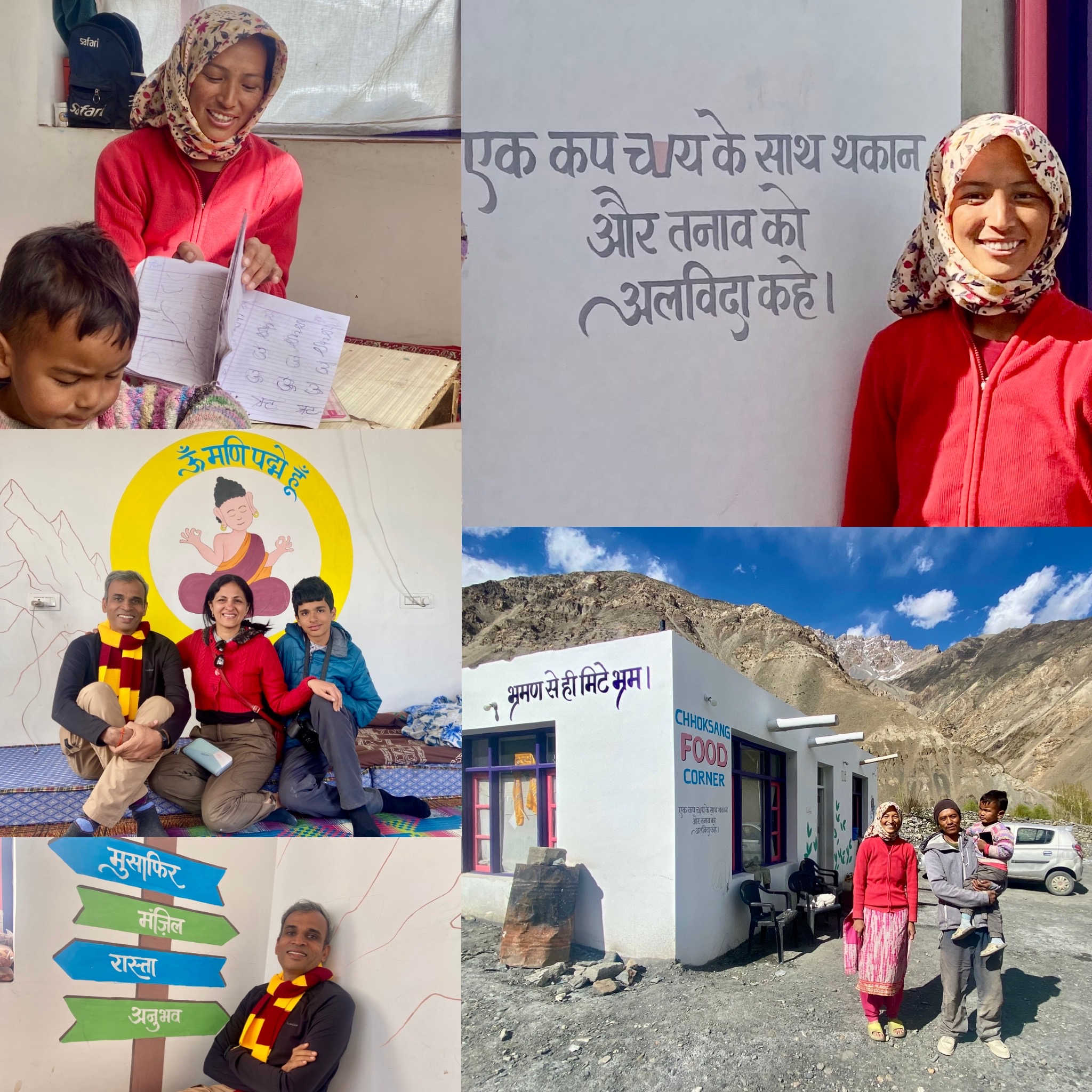
On our way back from Gue Monastery, right at the village entrance, a hand-painted quote caught my eye on a small white house:
“भ्रमण से ही मिटे भ्रम”
(“Travel is the only way to dissolve illusions.”)
Beneath it, in quiet elegance, was written: Chhoksang Café.
Drawn by the art and the words, I stopped to take a picture.
A young woman nearby, working in the sun, smiled warmly and said, “Yes, café is open—please come in.”
I told her I had just eaten, but she replied with a laugh,
“No worry! Come in to rest. Share your stories.”
How can you deny such an invitation? And so we entered her one-room café, which is her home and a treasure trove of art, energy, and soul.
Inside, the walls were covered with beautiful calligraphy, murals, and travel quotes—all painted by a group of artists who had once stayed with her. Inspired by her life and spirit, they left behind their brushstrokes as a gesture of gratitude. Every corner of her space told a story—not just of Spiti, but of dreams, struggle, and soul-deep resilience.
Dolma moved here from Kaza with her husband, who works for the Border Roads Organisation. With no school nearby and no means to afford boarding schools, she decided to teach her 4-year-old son on her own. She told us that they are a Below Poverty Line (BPL) family and started this café within the house to make ends meet.
She then served us steamed momos made from wheat flour ground in the village’s water-run mill. Every ingredient—fresh, organic, grown right on their tiny patch of land. While the food was delicious, what moved us most was her spirit.
She spoke about life near the China border, the Indian Army’s connection with the village, and the mysteries of the Gue Mummy with a sparkle in her eyes. Not a trace of self-pity—only laughter, pride, and stories to tell.
And then we saw the wall of passport-sized photos. She told us, “This is my new project. Every guest who visits, I request that they leave a photo. When they return, they can find themselves here again.” We left ours there too, beside dozens of travelers who had, like us, discovered this extraordinary woman in an unassuming village.
We wish her café finds the success it deserves, and that her son gets the bright future she’s working so hard to build.
As we waved goodbye, I thought that all she has is a small farm and a one-room house with unimaginable hardships of a remote village. But her radiant smile and positivity transformed that into a portal of art, food, culture, and hope. Dolma reminded us that even in remote places, in tiny one-room homes, great courage and boundless beauty thrive.
📍 Chhoksang Café, Gue Village
Right near Gue Monastery (home of the 500-year-old mummy)
👉 Visit her here and leave your story on her wall
Instagram- @chhoksang_cafe
Tanzim & Chhering – The siblings who became a portal to the Spiti’s soul
(Spiti Tara Homestay, Kaza)
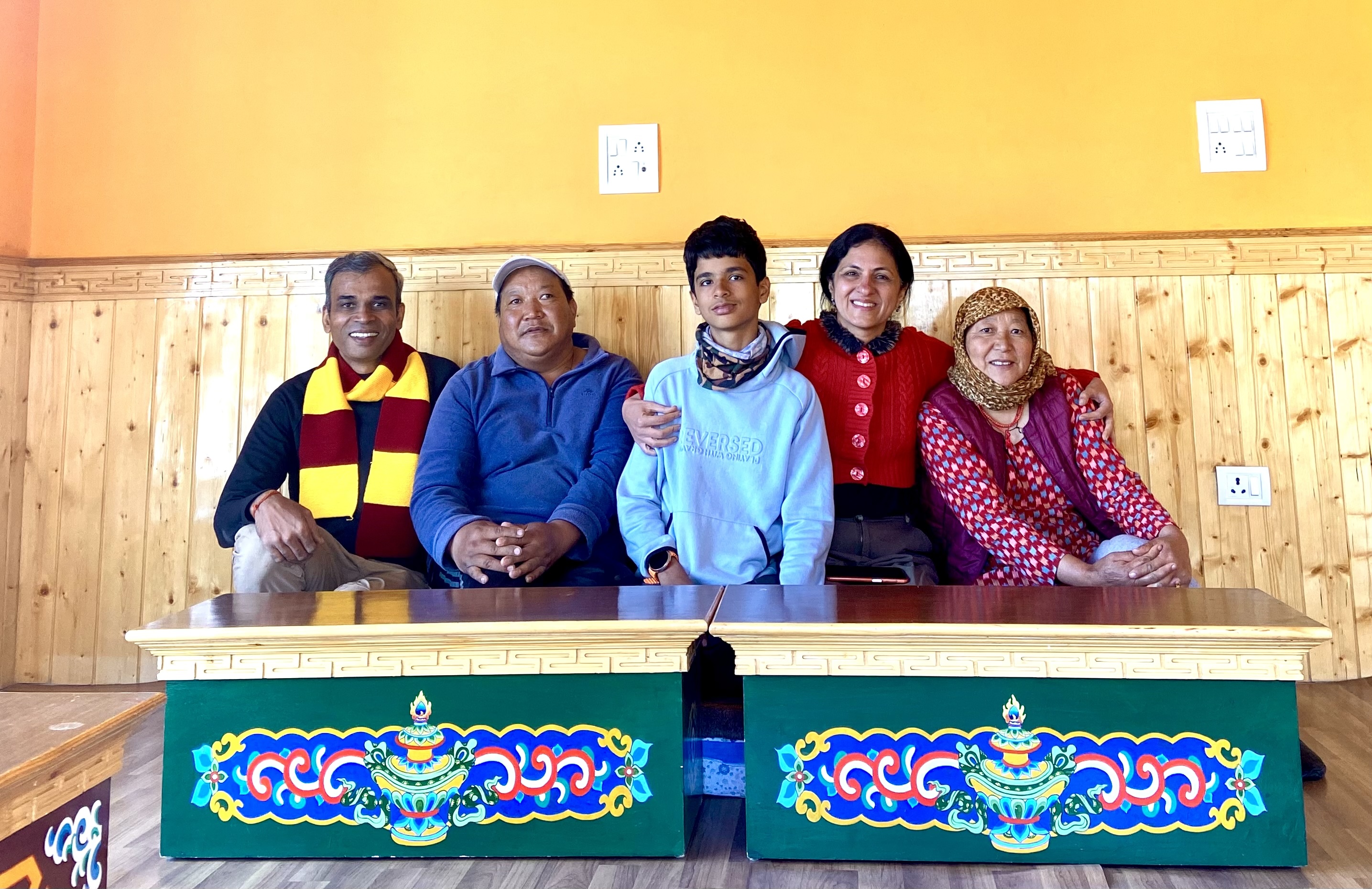
If there was ever a doorway into the spiritual soul of Spiti, it was through the hearts of Tanzim and Chhering—a brother-sister duo who opened not just their home to us, but a whole world of kindness, culture, and warmth.
We stayed at their lovingly built Spiti Tara Homestay in Kaza, and from the moment we arrived, it didn’t feel like lodging—it felt like we were home. Chhering greeted us like an elder sister, with the comfort of someone who’d known us for years. She remembered every little detail and cared for us with quiet strength and grace.
Tanzim, with his broad smile and signature cowboy hat, was not just a chef but a storyteller and a gentle force of nature. He cooked the most delicious traditional Spitian meals, prepared in a way you won’t find anywhere else in the valley. In the evenings, after our nature trails, they welcomed us into their beautiful dining room—soft lighting, warm ambiance, and breathtaking views of the majestic Himalayas. As we settled in, they would make us nourishing Seabuckthorn tea and then turn to my son with genuine curiosity, asking, “How was your day? What did you see? Which birds did you find today?” Those moments felt like a tender bridge between adventure and home, wrapped in kindness and wonder.
They shared stories of their family, their Buddhist lineage, and how they care for each other and for the fragile, beautiful Spiti Valley.
During our stay, tensions were rising between India and Pakistan, and most tourists had cancelled their plans. We were the only family at the homestay. When we asked about it, they told us something that speaks volumes about who they are.
Many travelers who had booked stays had sent cancellations, and some even offered to forfeit part of their advance as a gesture. But Tanzim and Chhering refused to keep a single rupee.
“If you haven’t stayed, we have no right to take your money,” they said, simply.
This is not business. This is dharma.
They live and serve by the deep-rooted Tibetan Buddhist philosophy of right livelihood—where simplicity, honesty, and compassion are not marketing lines, but everyday practice.
One evening, we asked about Spiti’s tradition of sending a child to the monastery.
“Isn’t it difficult for the child and the parents?”
Chhering smiled gently:
“It’s a privilege to raise a child who chooses the monastic path. The monastery isn’t separate—it’s part of the family.”
We soon realized that their spiritual grounding transforms the relational anxieties we carry from city life.
On our last day, when my wife Sonali told Chhering she wanted to buy seabuckthorn tea, Chhering went into her personal kitchen and brought back a stash from her native village.
Spiti Tara itself is a warm and beautiful home—wooden ceilings, carpeted rooms, large windows framing the mountains, and clean bathrooms with 24/7 hot water. But it’s not the structure that stays with you.
It’s Tanzim’s laughter.
Chhering’s gentleness.
The quiet strength of a home built on love.
The mountain spirit that whispers through their stories and stews.
📍 Spiti Tara Homestay on Google Maps
Instagram- @spititara_homestay
Tashi Gialson– The Villager who walks with snow leopards
(Birding guide · Snow Leopard tracker · Chicham / Kaza)

Sometimes, in search of rare wildlife, you end up discovering even rarer humans.
That’s exactly what happened when we met Tashi—a quiet, dedicated snow leopard tracker from Kibber village near Chicham Bridge. He became our birding guide for a day and left a mark on our hearts forever.
My 13-year-old son, Samay, is a passionate young birder. His dream was to spot the Eurasian Eagle Owl, said to be nesting near Chicham. While most tourists were checking off monasteries and landmarks, we were trekking rocky slopes searching for a shadow on a cliff. Despite hours of trying, no luck.
That night, we got Tashi’s number through a local contact. It was 9 PM when we called.
We explained we had just one day left. Samay was desperate to see the owl.
To our surprise, Tashi said, “Come to my village by 6 AM. I’ll help you.”
Before sunrise, he hopped into our car and guided us straight toward the cliffs. We spotted the owl! But just as we raised our cameras, it slipped into a rocky crevice and disappeared. Still, we waited.
Like a mentor, he guided Samay, “In the wild, if you chase birds, you may find some, but if you sit at a point, many more will visit you themselves”. Samay followed his advice and spotted beautiful birds including– Blue Rock Thrush, Fire-fronted Serin, Chukar, Bearded Vulture, and Blue Sheep
We sat with Tashi for over three hours as he shared stories of snow leopards, Tibetan wolves, and Himalayan ibex, flipping through photos from his logs like a proud guardian of the wild. Each tale revealed his quiet reverence for every being in this pristine valley—especially the elusive snow leopard.
At one point, he recounted seeing a snow leopard fall from a cliff while hunting ibex. As he spoke, his voice trembled, and a shadow passed over his face—as if a dear companion had met an untimely end. It was deeply moving to witness the kinship he felt with the animals of this land
Then he took us across to Hikkim to search for Himalayan Snowcock and Griffon Vultures. His instincts were razor-sharp—every call, every rustle, he knew. Samay got to see nearly every bird he had dreamed of.
We watched in awe as Tashi would suddenly leap off the road and sprint across steep cliffs to follow a birdcall. What amazed us more—he was only supposed to be with us for a few hours, but he stayed the entire day.
And he wasn’t done.
At sunset, we returned to the owl’s nest. We managed a photo this time. Then, seeing how much it meant to Samay, Tashi took our camera, climbed across a dangerous cliff himself, and tried to get a close-up. The owl hid again—but that moment, that effort, will never be forgotten.
Later, we met his mother, who sells local food and hand-knit socks at Chichum Bridge. We met his wife, who said softly, “Tashi wasn’t feeling well that day, but he didn’t want to disappoint your son.”
That’s when it hit us—Tashi wasn’t just a brilliant tracker.
He was a kind, selfless soul, doing everything not for money or praise, but for love.
Love for the land. For nature. And for the wonder in a child’s eyes.
In the land of snow leopards and soaring vultures, we found a human just as rare, just as majestic.
Tashi—thank you. 🙏🏼
📍 Chicham & Kaza, Spiti Valley
(DM for contact details if you’re heading there—he’s a treasure.)
Follow him on Instagram— @tgialson
Sonam Tara – The Elder Who Built a Haven at the Edge of the World
(Tara House Homestay, Mudh Village)

Raj, our ever-thoughtful guide and friend from Spiti, insisted we visit Mudh Village in Pin Valley—and more importantly, that we stay at Mr. Sonam Tara’s homestay. What followed was a journey that tested our nerves and rewarded our hearts.
We drove for hours through steep valleys and narrow, unpaved mountain roads—twisting deeper into the remote folds of Himachal Pradesh—until we reached the last village in Pin Valley. And what a reward it was. Snow still hugged the landscape in May. The village sat like a dream at the tongue of a glacier. From Mr. Tara’s house, we could literally walk on snow. We heard snow cocks calling and watched Chukars run past in the distance.
Mr. Sonam Tara greeted us with a calm, confident, and deeply grounded presence. A quiet, caring man whose eyes reflect the mountains he’s called home for two decades. His family joined in hosting us with such grace—it felt less like a homestay and more like staying with friends in a secret, snowy corner of the world.
His daughter, cradling her 7-month-old son Jigme on her back, helped manage the rooms and passed on cooking instructions to the kitchen. Meanwhile, her two daughters—aged 3 and 7—along with the village children, laughed and played with my son in the crisp mountain air.
When I asked Mr. Tara about wildlife in the area, he didn’t just speak—he walked us to a neighboring terrace and pointed to the cliffs where we’d spot Ibex and snow cocks the next day. That moment stayed with me. No rush, no show—just wisdom quietly passed on.
He shared how he was the first person to settle here, long before a road existed. Once the road was built, he created the first homestay in the village. Over the years, he’s hosted international trekking expeditions, scientists studying the region’s unique wildlife and geology, and travelers like us who are lucky enough to find him.
Even today, during heavy snow or rain, the road to Mudh can be cut off for months. But Mr. Tara takes it all in stride. A seasoned trekker himself, he invited us back for future expeditions that begin right from his doorstep, deep into the snow-clad Himalayas.
We couldn’t meet him at the checkout because he left early that morning to take his seven-year-old granddaughter to a boarding school near Kaza. The little girl’s mother explained that since Mudh is such a remote village, they need to send their children to boarding schools. We wondered if it was appropriate to send such young kids away to a boarding school. She assured us with a smile that “there’s nothing to worry about, since the school is an extension of the community and the staff are like family.” Once again, we realized that the separations we experience in city life dissolve into the deep spiritual interconnectedness felt by the people of Spiti, even in such a vast and spread-out mountain landscape.
I left Mudh deeply moved by the calm strength, resilience, and compassion of this village elder—and the quiet brilliance with which his family is building something magical in the middle of nowhere.
📍 Tara House Homestay on Google Maps
Monks & Monasteries of Spiti — The Resilient Whisperers from the Roof of the World

While travelling in Spiti for hours, we were often the only car on roads winding through steep 14,000-ft cliffs, barren mountains, frozen rivers, rolling rocks. And then, through the silence of snow and stone, we would suddenly see: a vibrant monastery perched on a ledge, prayer flags dancing in the sky, and a monk’s gentle smile. You wonder—how do people live in this harsh terrain?
The answer lies in centuries-old monasteries and deeply resilient monks who’ve nurtured this land with faith, simplicity, and boundless compassion.
In Tabo, we climbed centuries old meditation caves where monks endured winters of -30 °C in silence. I could feel their resilient presence in my breath. Later, at the 1,029-year-old Tabo monastery, a young monk sensed our inner seeking and guided us into a dark, sacred chamber. There stood a thousand-year-old Buddha, radiating timeless wisdom and compassion.
In Dhankar, an elder in a cowboy hat gently directed us to the sacred lake. Snow and wind turned the trek into a pilgrimage that eventually rewarded us with calm waters, blue skies, and a stillness of ancient wisdom. Later, an elder Lama at Dhankar Monastery invited me to meditate in a mud chamber with coins pressed into the ceiling. It felt like a womb of the world. When I came out after a short but deep meditation, he smiled, as if to say, “Yes, that peaceful lake lies within us too.”
Finally, on our way back, we stopped at Gue Monastery and met the 500-year-old self-mummified monk who dedicated his life to serving his people and land. No chemicals were used—only his own meditation and breath. Scientists still marvel that his nails and hair continue to grow. Is he alive or gone?
But spiritual practitioners know: he entered a deep meditative and tantric yogic state where subtle breath is enough to transcend the duality of life and death.
Each monk, each monastery—a living scripture of human transcendence.
They are the quiet, powerful heart of Spiti.
💫 Each one a story. Each one a blessing.
#HeartfulHumans #SpitiValley #HimalayanWisdom #SacredStories #TaboMonastery #DhankarLake #GueMummy #HimachalDiaries #HeartfulHumansofHimanchal
Sushil Raj – The invisible thread that weaved our journey
(White Lotus Homestay, Tabo)
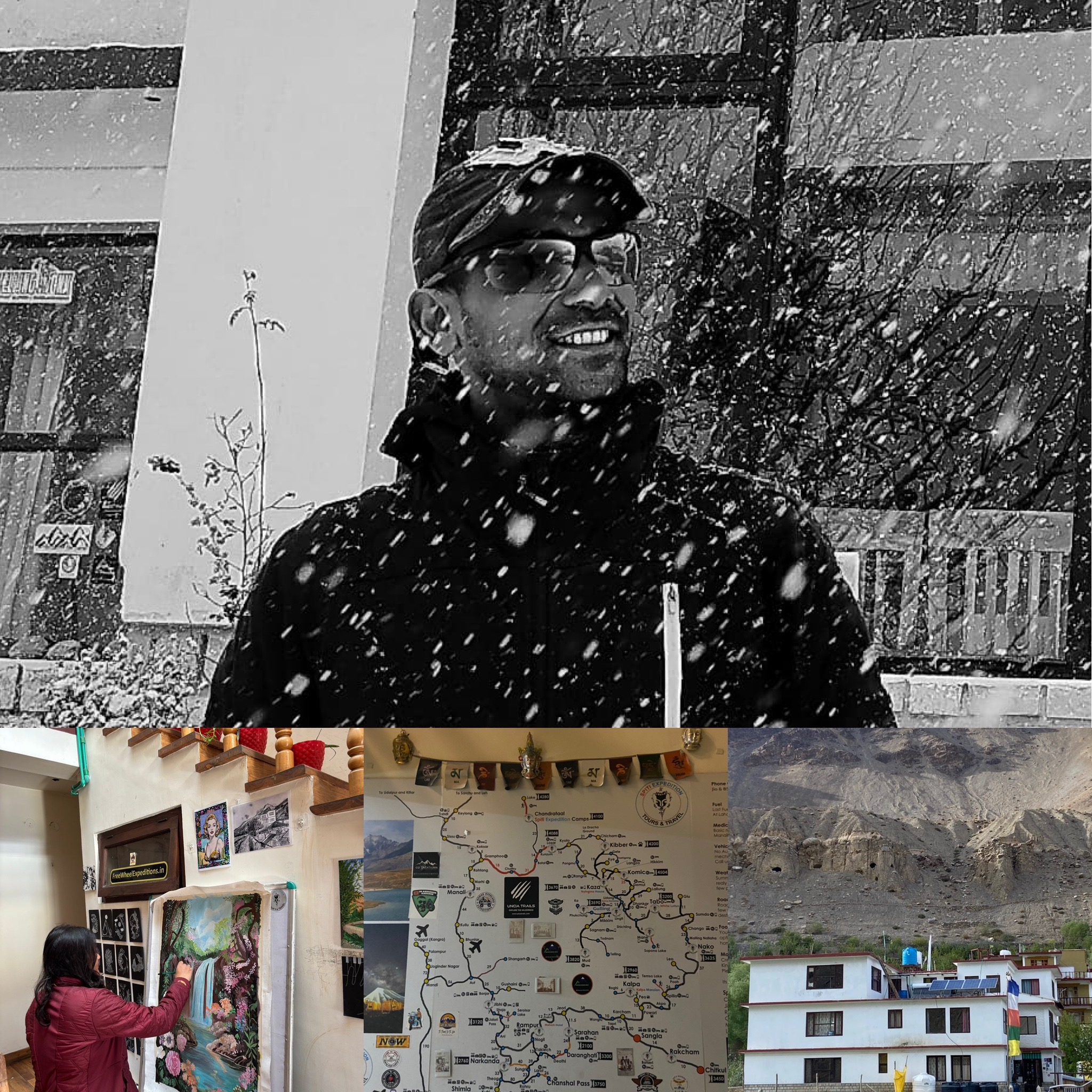
Some people leave an impression without ever stepping into the same room as you. For me, Sushil Raj is one of them—a name I now associate with warmth, generosity, and the kind of care that defines the spirit of Spiti Valley.
I was introduced to Raj by my dear friend Artika, who had visited his homestay—White Lotus—in Tabo the previous year. Even though Raj was working in the rural corners of Madhya Pradesh during our travel dates, he became an invisible but constant presence throughout our trip.
He didn’t need to help. But he did—going out of his way to call us several times a week—before, during, and even after our journey. Whether it was advice, logistics, local contacts, or just checking in to ensure we were safe and at peace, his care reached us from miles away.
I haven’t met Raj in person yet. But I’ve met him through the people he so thoughtfully connected us with. Through his amazing team at White Lotus Homestay, where his spirit lives in every gesture of kindness, every warm smile, every thoughtful detail. I’m particularly grateful to Heena, who has recently joined the team. She welcomed us like family, shared her art and warmth, and made every interaction feel personal.
Tabo is often called the heart of Spiti. And White Lotus? It’s the heart of Tabo.
Tucked just a short walk from the main road and the gentle flow of the Spiti River, White Lotus is more than just a homestay. It’s a beautifully designed space with cozy, carpeted rooms that offer stunning mountain views, warm water, electric blankets, and a vibe that feels alive with stories and soul.
But what truly sets it apart is Raj—the one who co-created it, and who continues to breathe life into it, no matter where he is. He helped guests plan entire itineraries, offered local insights, and made sure every traveler under his wing felt cared for.
📍 See White Lotus on Google Maps
Thank you, Raj, for being the invisible thread that wove our Spiti experience into something unforgettable. I hope we meet in person someday—but even if we don’t, your spirit will always be part of the memory.
Vicky & Bittu – The Wayfarers of the Last Village
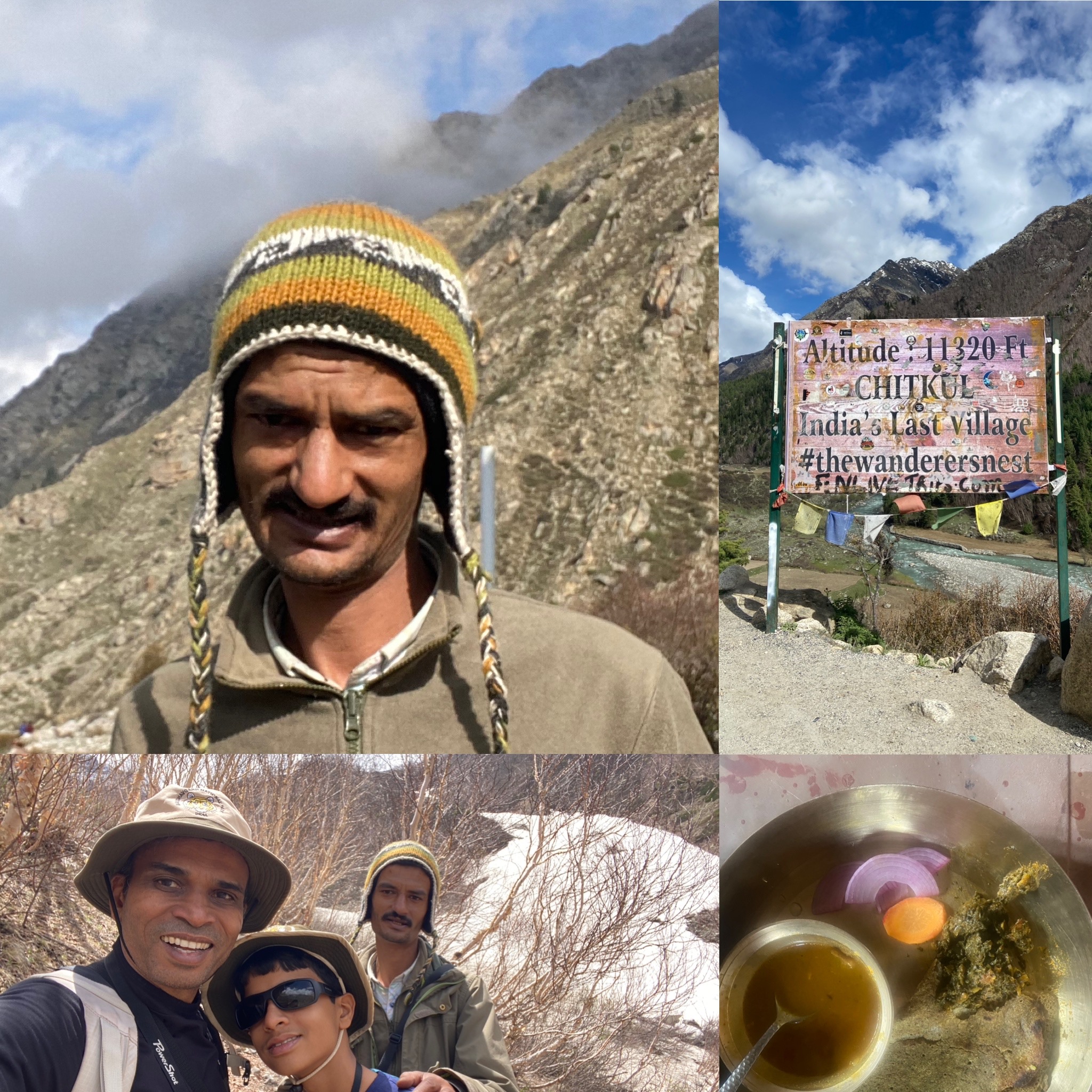
High above the last village of India—Chitkul, at a serene spot —sits Mannat Homestay—a cozy haven that feels less like a guesthouse and more like a warm hug from the Himalayas. We were fortunate to stay here. But even more fortunate to meet Vicky and Bittu, the two kind hosts of Mannat
Vicky, once an expedition guide, is a living map of the region. He doesn’t just know Chitkul—he feels it. On our trek to a nearby glacier, he walked with us for five hours, sharing stories of the local wildlife, the history of the valley, and the soul of the village. He shared with us how he once found a wounded golden eagle and brought it to Mannat to nurse it until it was ready to fly. His knowledge is rich, but it’s his generosity and patience that truly moved us. While still guiding on the hike, he managed to find a spot with a network and called his friend Bittu to organize an awesome local surprise for us.
Bittu, is a quiet magician in the kitchen. On Vicky’s cue, he prepared a traditional meal using local buckwheat, followed by warm, soul-soothing seabuckthorn tea. Nourishing, simple, and full of love.
What Vicky and Bittu offer at Mannat Homestay isn’t just hospitality. It’s that rare feeling of being cared for by strangers who quickly feel like old friends.
If you’re heading to Chitkul, don’t just look for a place to sleep. Look for people like them. Look for Mannat.
The views? Breathtaking. Snow-capped mountains from every window, the sound of birdsong in the crisp air, and a short walk to the temple and village market. The rooms were just as comforting—cozy, clean, and quiet, with hot water always ready. But what made this place unforgettable wasn’t the location or the amenities.
📍 See their homestay and reviews here
Om Prakash Sharma – The Chemist Who Embodied the Integrity of Mountains

On the eve of our Spiti adventure, I visited a small chemist shop in Narkanda to buy essentials. Amidst the flurry of travel prep, I mistakenly paid double the amount via GPay. An hour later, as we dined, a worried elderly gentleman entered the restaurant—it was Mr. Om Prakash Sharma. He had shut his shop and gone searching through every eatery in Narkanda just to return ₹400.
When I offered to wait until morning, he said, “I won’t sleep knowing someone else’s money is with me. God has given me enough—I won’t take what isn’t mine.” The next morning, I stopped by again to thank him. He showed me products a distributor had mistakenly delivered extra—he was keeping them untouched for return. That’s Om Prakash—a living embodiment of integrity. A true Himalayan soul.
If you are travelling to Narkanda/ Shimla/ Kinnaur/ Spiti, pls visit him on the way in Narkanda market— https://maps.app.goo.gl/4T28uJHpnX9YxhKf6
The Aunties of Narkanda — Who simply love to cook and serve
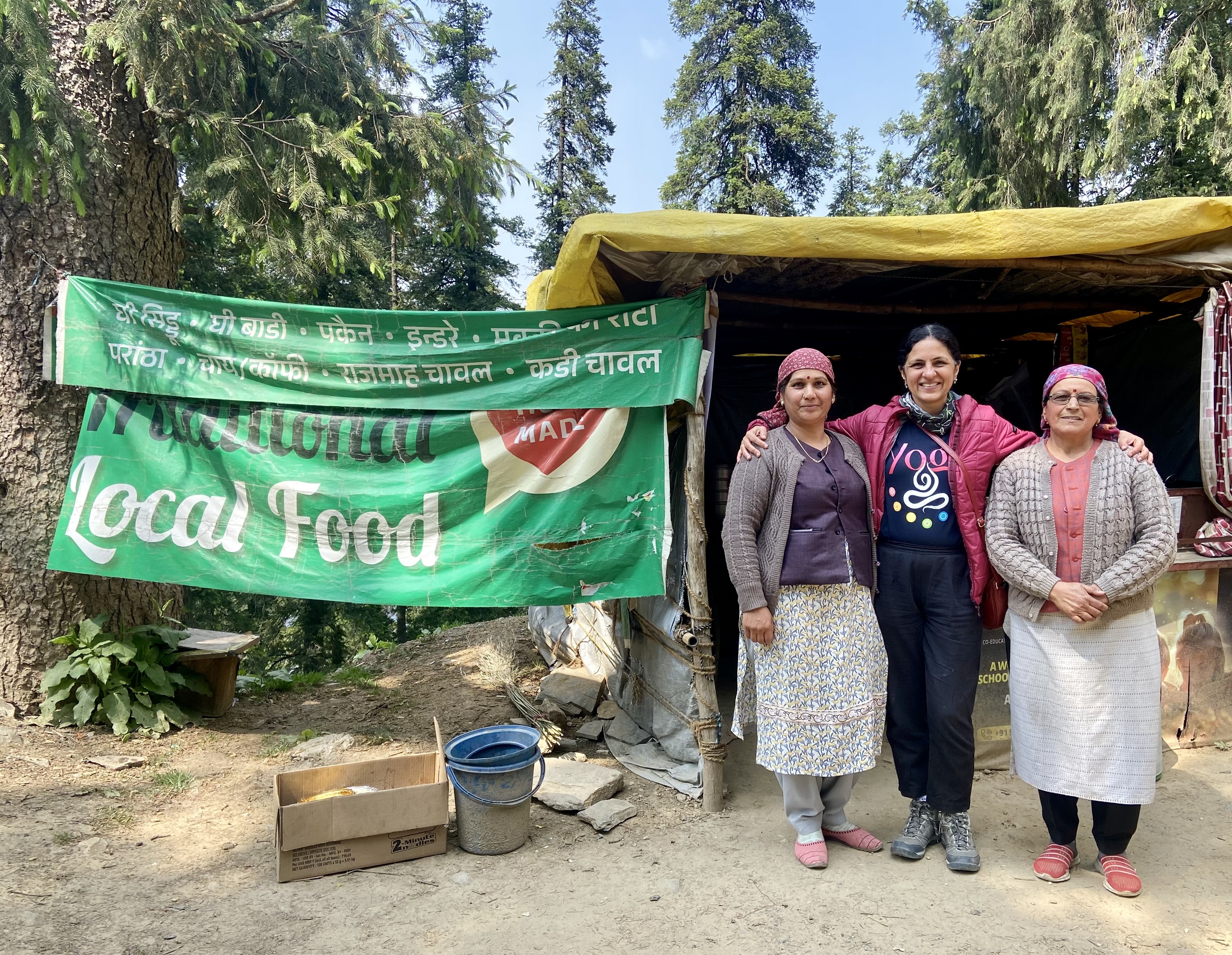
Before we began our Spiti journey, my wife came back from an evening walk in Narkanda and said,
“I just had the most amazing thing—SIDDHU—from this roadside stall called The Aunties of Narkanda. You’ve got to try it on the way back.”
We left early the next morning and missed them.
But as we returned after our Spiti odyssey—we finally stopped by this tree-shaded food stall that locals and travelers alike call “The Aunties of Narkanda.”
And what we found was pure magic.
Two women—one elderly, one radiantly cheerful—welcomed us with smiles that felt like home.
They were surrounded by hungry travelers, uniformed police officers, and young bikers. Everyone was sharing food and stories.
They served us Siddhu—the most heartwarming local delicacy, soft and filled with goodness—along with Rajma Chawal that my son declared the best of the entire trip.
But what truly stirred me was their story. They started this roadside kitchen with nothing more than a hut under the trees and a deep faith in the power of their food. No fancy menus. No restaurant signs.
Just flavors passed down for generations, served with honesty and heart.
And somehow, the world found them.
Travelers posted about them. Word spread. Now they’re quietly viral—not because of strategy, but because of substance.
If you ever pass through Narkanda, skip the cafes.
Go find the aunties. Sit on a stool. Order the siddhu. Ask for their rajma.
And listen to their journey—served hot, with a side of mountain resilience.
📍 The Aunties of Narkanda – just off the highway under the trees
Find them here— https://maps.app.goo.gl/nqGj65DDg2uMMsSo8
Sunil and Nitin – Our True Travel Partners Through the Mountains of Himachal
(A story of two kind souls who turned our road journey into something unforgettable)
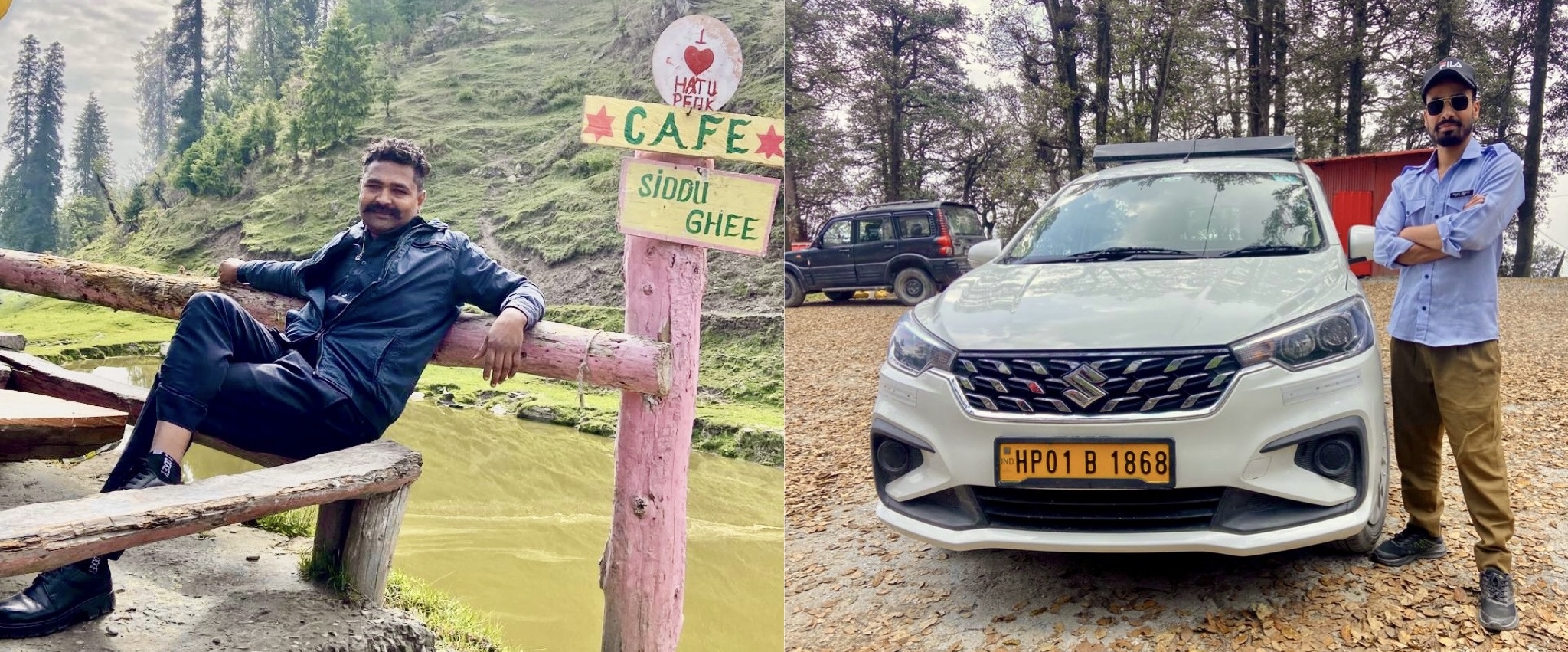
Our journey through Himachal’s mountains began and ended with two men who were meant to be “just our drivers.”
But they became so much more—companions, co-explorers, wildlife spotters, and dear friends.
First came Nitin.
He picked us up from Chandigarh—disciplined like a soldier, but with the soul of a wanderer. From the start, he was warm, observant, and deeply tuned in to our needs—especially kind and affectionate towards our son.
On our first morning in Narkanda, before sunrise, we drove up to Hatu Hill in search of the Himalayan Monal. Nitin could have just been a driver. Instead, he became a true part of the mission.
He asked our son to sit beside him in the front, listened to his observations, and adjusted his driving to suit the silence and stillness birding demands. He drove slowly through forested bends, cut the engine quietly, and stopped just in time when the first Monal appeared on the trail.
The next day, he surprised us. He had stayed up late reading about the birds of Hatu. He downloaded the Merlin Bird ID app, eager to support our sightings better. With growing excitement, he helped us spot Koklass Pheasant, Kalij Pheasant, Common Quail, and Himalayan Woodpecker. He didn’t do it for show. He was simply moved by the joy it brought our son.
“If your son loves birds this much,” he said, “then I’ll do what I can to help him find them.”
Then came Sunil Thakur.
He joined us in Narkanda for the Kinnaur–Spiti leg of the journey. Sunil’s quiet steadiness was unforgettable. We noticed two things almost immediately: his extraordinary driving skill and his gentle sensitivity.
Even on rough terrain—gravel, narrow ridges, no roads at all—he never rushed. He drove with a calm that made even the wildest roads feel safe.
A few days into the trip, tensions flared at the India-Pakistan border. Sunil received a worried call from his family. We assured him, “You’re one of us now. We’re all in this together.” And from that moment, the dynamic shifted. He was no longer just helping us navigate the road—he was part of the journey itself.
At first, he was puzzled by our slow, quiet travel style. We weren’t chasing popular landmarks—we were scanning treetops for birds, crouching near riverbanks to look for wildlife, and chasing moments of silence.
But soon, Sunil became a birder too. He began scanning ridges for movement, pausing the car with a quiet “Woh dekho…” and borrowing our binoculars with curiosity. He showed tremendous patience as my son stopped the car or we trekked down in search of Chukar Partridges, Eurasian Griffons, Blue Sheep, or Snow Cocks.
He took pride in spotting things we missed and started reminding our son to keep his camera ready before bends.
“I saw a big bird there yesterday,” he’d say. “Let’s slow down and check again.”
Weeks after we returned, he called me to say:
“Next time, please come to my village. It’s full of birds. Your son will love it.”
That small message meant everything.
Between Nitin and Sunil, we didn’t just cross valleys, rivers, and mountains.
We found care, humor, intuition, and deep human connection—gifts that can’t be booked in any itinerary.
If you plan to hire a car in Himachal Pradesh, pls message me for Nitin or Sunil’s number
The Invisible Hands That Make the Himalayas Accessible — A Salute to the Border Roads Organisation (BRO)
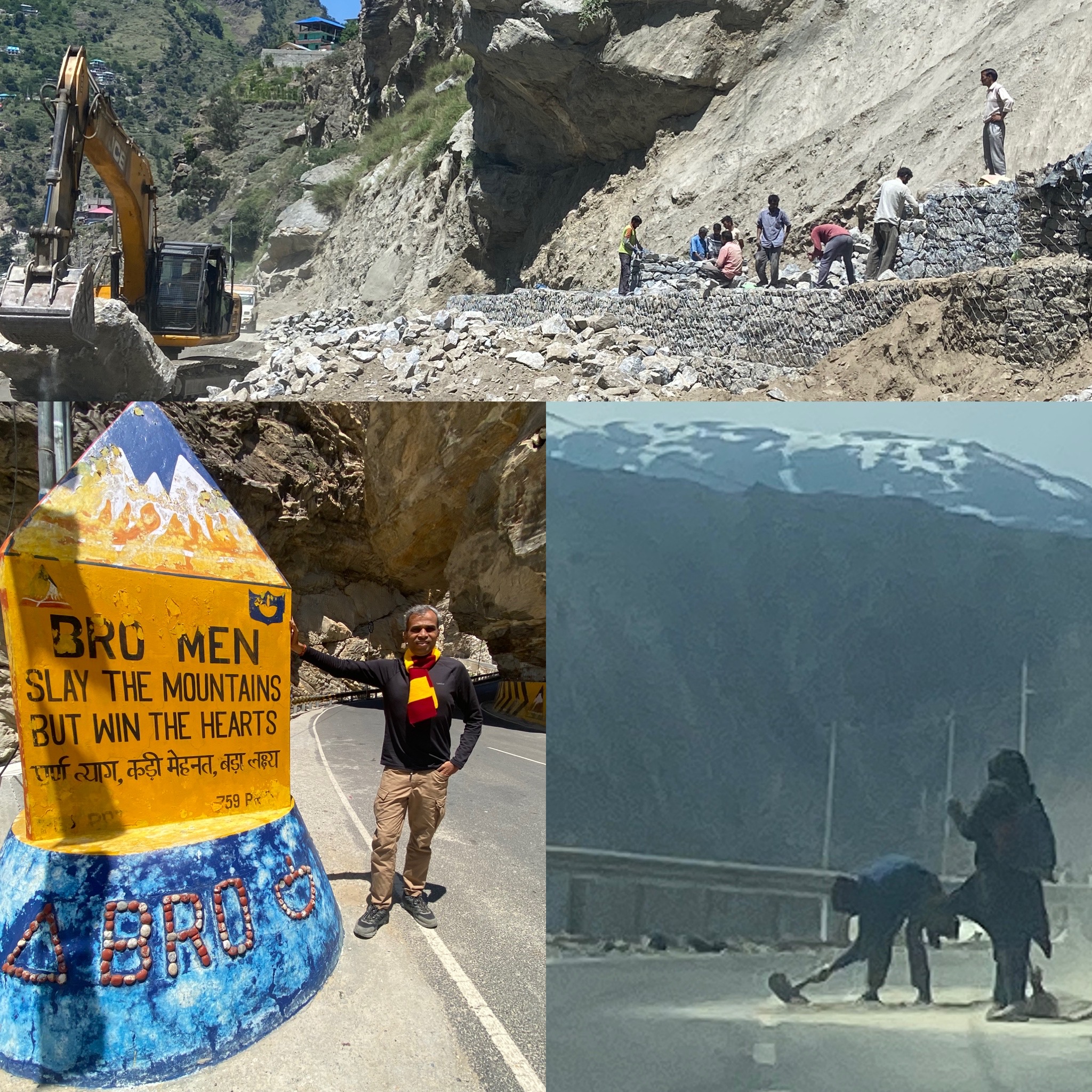
(Mountains, People, and the Roads That Hold Them Together)
When I returned from our unforgettable trip to Spiti Valley, a friend asked me,
“What stayed with you the most?”
And three things came to my mind—
First: The majestic, untamed mountains of Spiti. Jagged cliffs. Raw rock. Land so rugged and sacred, it humbles every part of you.
Second: The resilient people—who live there, cut off from the world, yet full of warmth, strength, and grace.
And third—surprisingly, but deeply—
The Roads.
Yes, the roads.
Those unbelievable mountain roads, carved through cliffs, rivers, and snowfields. Winding through silence. Smooth in places, broken in others. But always there.
And with the roads came the quiet presence of those who build and maintain them—
The Border Roads Organisation (BRO).
All through our journey, we saw them—not as a single force, but as countless individual souls: Village men clearing loose rocks by hand, Earthmovers restoring broken bridges, Cranes parked on impossible cliffs, Women and men waving us on through dust and rockfall, And the signboards—oh those BRO signboards—
“Don’t be a GAMA in the land of LAMA”
“Drive on horsepower, not rum power”
“Be gentle on my curves”
“After whisky, driving risky”
“Feel the curves but never test them”
Humorous, wise, and strangely intimate reminders of our fragility in the mountains.
Our driver kept repeating in awe:
“BRO ne toh kamaal kar diya bhai, nahi toh koi yahan tak pahuch bhi nahi sakta tha.”
(BRO has done wonders—without them, no one could have reached this place.)
Because without BRO, there is no Spiti road trip.
There is no access to these ancient valleys.
No connection for the local communities to markets, schools, or hospitals.
No journey. No arrival.
The BRO is not just building roads.
They are building bridges between worlds—civilization and wilderness, tourists and locals, dreams and destinations.
So this one is for them.
The Border Roads Organisation—a unit of the Ministry of Defence, working silently, selflessly, season after season.
They are the unseen hands behind every breathtaking Instagram photo from Spiti.
They are the reason we can travel into the heart of the Himalayas—and return.
🙏 Thank you, BRO.
You don’t just build roads.
You build access to wonder.
As we drove across winding passes and silent valleys, what stayed with us wasn’t just the grandeur of the Himalayas—it was the people who live there, love there, and quietly shape its soul. In some of the most unforgiving terrain on Earth, we found the softest gestures, the kindest smiles, and the strongest hearts. These were not just encounters; they were reminders. That resilience doesn’t always roar—sometimes, it sits by a stove serving tea, walks quietly behind goats, or pauses a car just in time for a child to spot a bird.
These stories reminded me to believe in nature—not just as a place, but as a teacher. And more importantly, they reminded me to believe in people. In every dusty track and snow-lined bend, I saw what it means to care without conditions. To offer warmth without words. To live simply, but deeply. In Himachal, the mountains may be mighty—but it’s the humans who make them unforgettable.
Sometimes, inspiration doesn’t come from a TED Talk—
But from quiet walks along untrodden Himalayan paths,
Where hope and humanity shine
In their most humble and unassuming forms.
Manish Srivastava
From the Sacred Well
 the sacred well