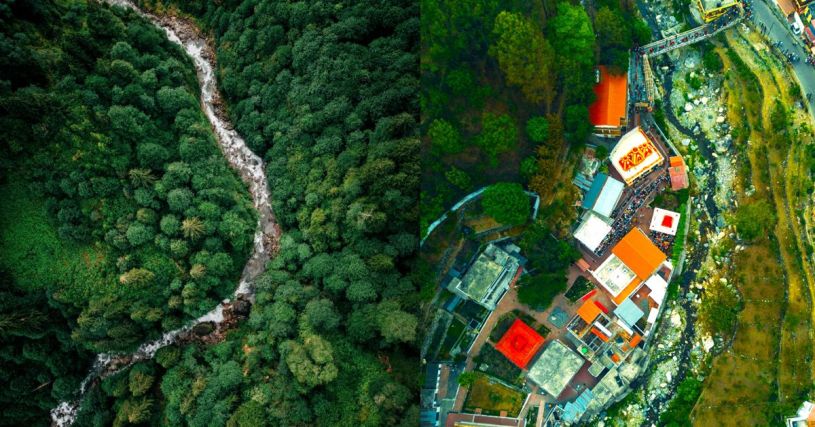
It would have been a routine run on a forest trail—had I not paused to listen to something that felt like a deep cry from the Earth itself.
This article is for two kinds of people.
First, for those who consider themselves deeply religious—God-fearing, rooted in the sacred heritage and culture of their land. People who visit temples, mosques, churches, and other places of worship. People who fast, who bow their heads before sacred objects. This article is for them. I am one of you.
Second, this article is also for those who do not relate to what is written above. Those who may not follow any particular religion or ritual. Those who may have a different relationship with God, or may consider themselves non-believers, scientific thinkers, or somewhere in between. This article is for them too. I am one of you.
⸻
When the Sacred Became Built
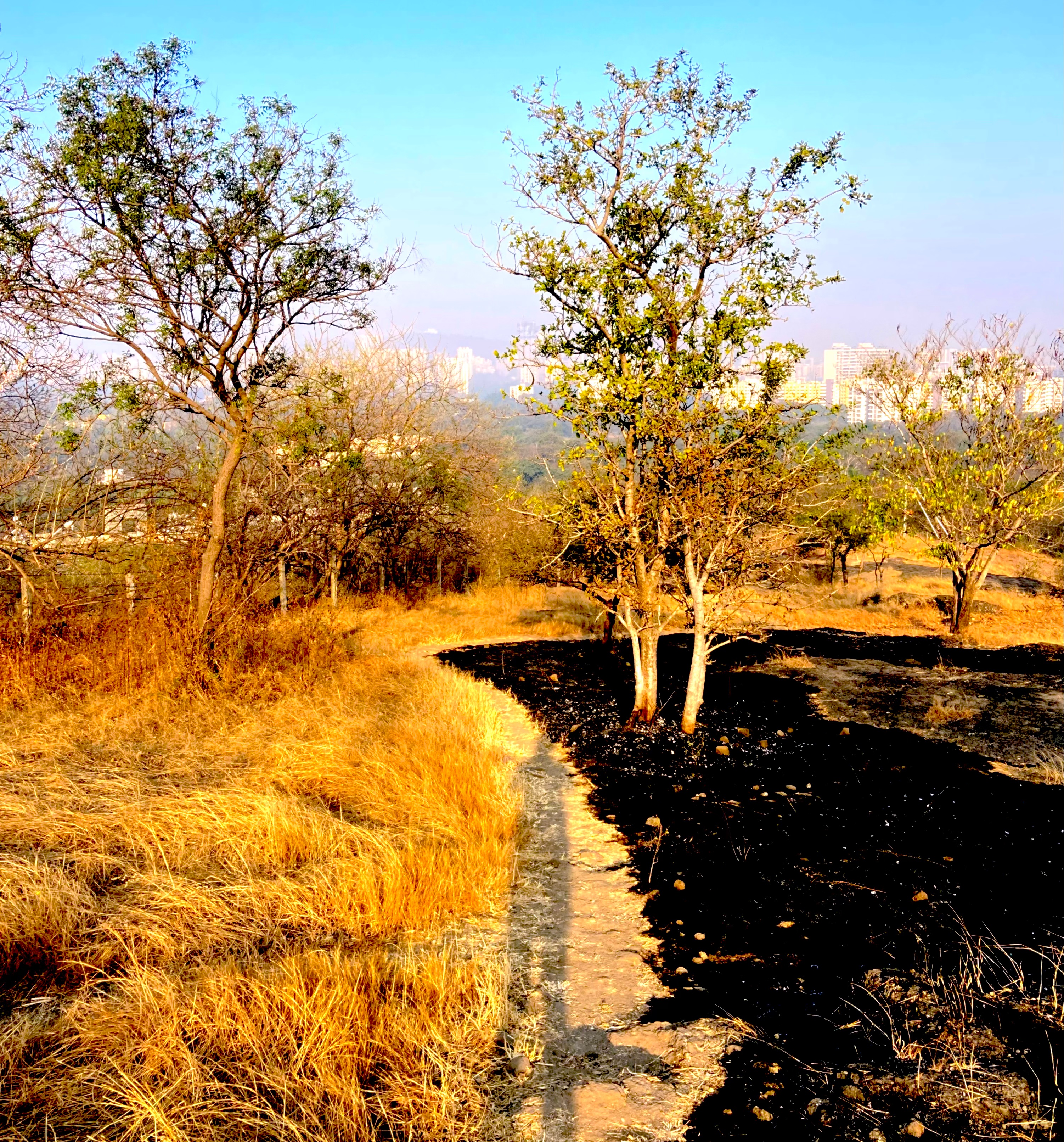
While visiting a local deity temple—or rather, what was once a spiritual spot—on the forested hill near my house, I had a realization that felt almost like a revelation. It made me aware of the changes this place has undergone over the last seven years, ever since I began coming here regularly during my morning runs.
This is the highest point of the hill—a place where many civilizations and tribal communities before me must have felt the presence of divine energy: a deep stillness, a reverence for nature. That is why a sacred stone was placed here. People must have once sat around it in silence, in awe.
I felt that same energy whenever I came at times when no one else was around. I could sit with old trees, songbirds, migrating avian visitors, and the occasional peacock.
Over time, human structures appeared. First, a small platform of bricks and cement. Then bells. Then steps. Then bright colors—red, yellow, saffron, a lot of saffron. More stones. Photographs. Flags. Festivals followed, modernized and amplified. With gatherings came plastic cups, thermocol plates, packets of sacred powder, and disposable flags. That needed more space—so trees were cut, land was cleared.
Now, it is a temple.
Naturally, political leaders have taken notice. Soon, a road will arrive. Cars will follow. Loudspeakers will come next. Rallies will be organized.
We have urbanized a place that was once sacred.
⸻
The Deep Voice of Earth
Today, when I reached the top of the hill, I felt partly grateful for the steps, for the cemented space to sit after a long run. I bowed to the sacred stone and asked the deity to help me walk the divine path.
As I turned to leave, my foot landed on a plastic packet—one that likely carried kumkum, the red sacred powder used in worship.
And then a voice came.
Not dramatic.
Not loud.
Just unmistakably clear.
“Do something about it. This is not fair. This is not divine. This is not worship.”
I knew it was my inner voice, yet it carried a weight and clarity that felt as though it were rising from the earth itself.
I stopped and asked, “What do you mean?”
“What do you see here?” the voice replied.
“It’s just a kumkum packet left by a devotee.”
“Look again. What do you really see?” the voice asserted with demanding clarity.
I picked up the packet. Cheap plastic. Chemically colored powder. Factory-made. Entirely out of place.
“Exactly,” the voice echoed. “This does not belong here. It is not an object of worship. It is an insult to my being. If you cannot care for the Earth, you cannot care for the divine.”
I looked around. The entire place was filled with plastic bottles, thermocol plates, and garbage scattered everywhere.
“You call this place sacred? Can you worship anything divine without honoring nature—the Earth and all her beings? Have you forgotten that Prakriti is the source of Purush?”
This time, the voice felt like a vibration rising from the depths of the earth. I had no answer.
“Stop this performance,” it continued. “If you want to serve me, start with yourself. Bring others with you. How do you separate me—the sacred—from nature, the grove where I belong? How do you exploit the five elements and still call yourself religious?”
As I walked down, my feet felt heavy—not touching earth anymore, but dirt created by humans. By people like me.
“I didn’t bring anything,” I protested weakly.
“You brought your silence,” the voice replied.
That cut deep.
“Bring what you have,” it finally said. “Your voice. Your creativity. Your privilege. Speak. Share. Transform this daily insult done in my name.” It spoke with piercing clarity.
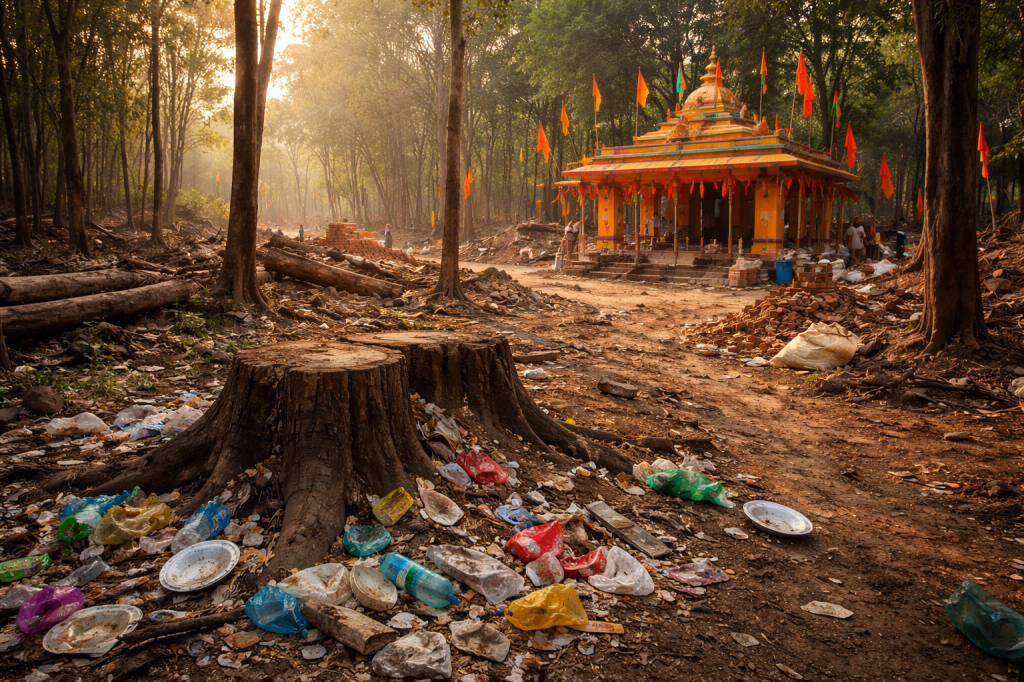
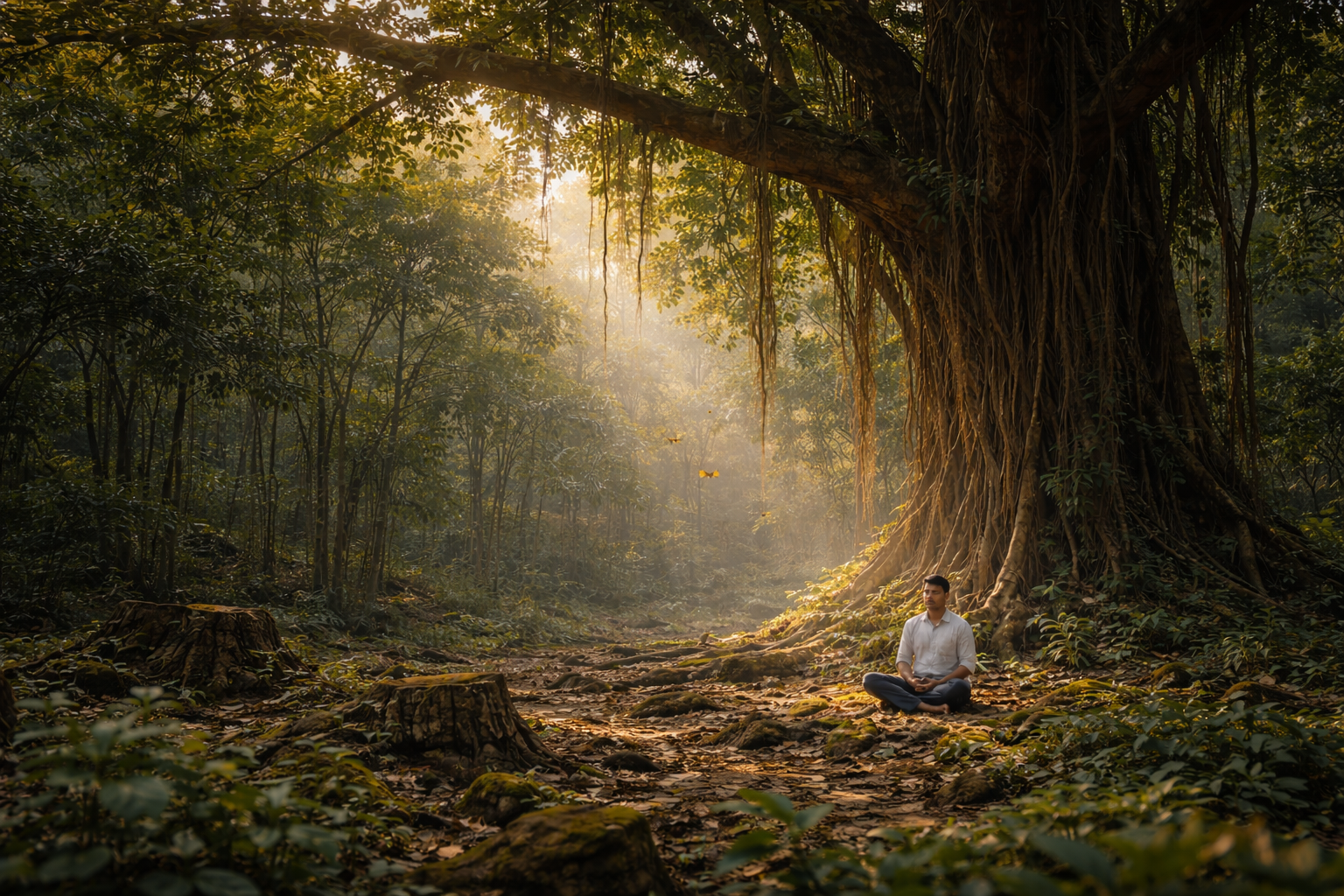
AI-generated representation
Destroying One Temple to Build Another
As I walked, I stumbled over something hidden beneath old thermocol plates.
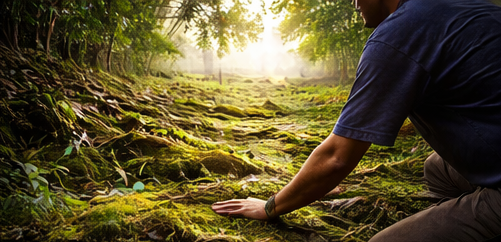
It was a tree trunk—two feet thick—chopped so violently that only a few inches remained above the ground. I knelt and touched it. Though cut years ago, it felt fresh. The roots were still alive underground. They could no longer grow. Above-ground life was gone, but memory remained.
I closed my eyes.
I felt the tree standing again—its strength, its vertical flow of water from earth to sky. A bridge between worlds. I saw birds nesting, squirrels leaping, insects living, humans resting, elders gathering, spirits dancing. I felt breath, health, seeds spreading, forests expanding.
This was the mother tree.
This was the deity.
In that moment, I understood something with piercing clarity: the tree is the blueprint of the forest—a microcosm of Prakriti itself. The tree is sacred. In a profound way, the tree is a temple.
No wonder so many scriptures were revealed beneath trees. No wonder our ancestors worshipped them.
And if the tree itself is a temple, how can we destroy one temple to build another?
How is this act any different from those who demolished temples to erect their own places of worship—those we label barbarians?
Who, then, are we?
⸻
Where the Sacred Once Lived
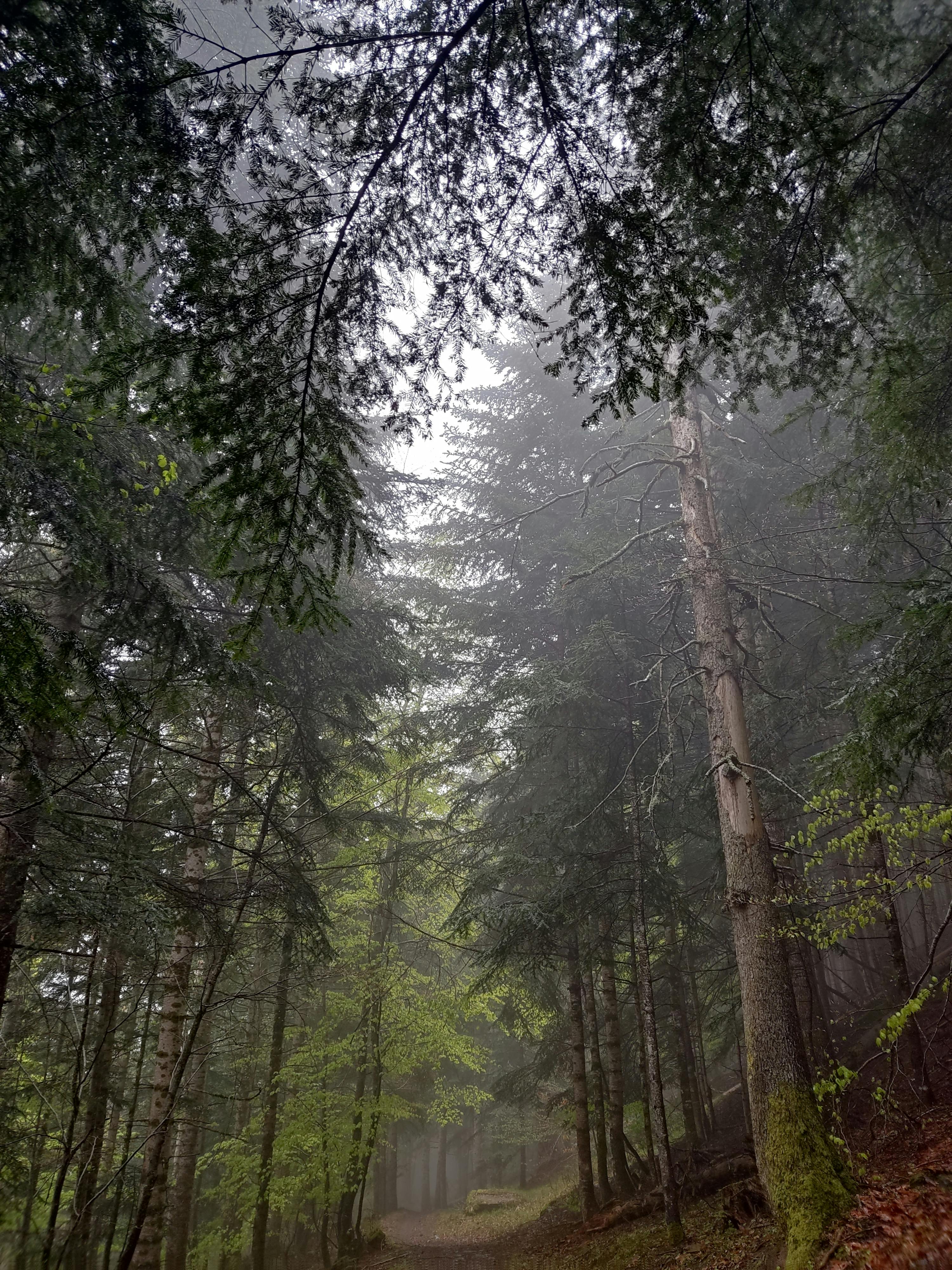
Across India, communities once protected forest patches as the abodes of local deities. Known as Devrai, or sacred groves, these were places where nature was revered rather than exploited, and where silence itself was believed to be divine.
These groves conserved biodiversity, protected water sources, and preserved rare species—but more importantly, they held a living understanding: the divine does not descend upon nature; it resides within it.
Near my village, we had such a place. I went there often to feel kinship with the living world.
That grove, too, has recently been cleared—for a temple project.
⸻
When Dana Destroys the Sacred
This logic of destruction disguised as devotion is not abstract—I have encountered it directly.
I remember visiting a temple near my village that stood beside a green riverbank, a few years before beautification construction began. A senior priest spoke to me with unmistakable spiritual authority and asked that I donate money for the temple’s expansion. When I hesitated—unable to reconcile devotion with the destruction it would bring to the riverbank—he insisted that this dāna was the surest way to earn puṇya.
That moment returns to me now as I stand on my hill, inside what remains of a sacred grove. The trees are cut. Birds—bulbuls and mynas—peck at prasād scattered by devotees.
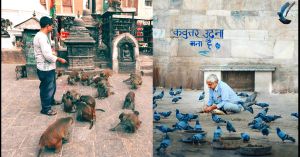
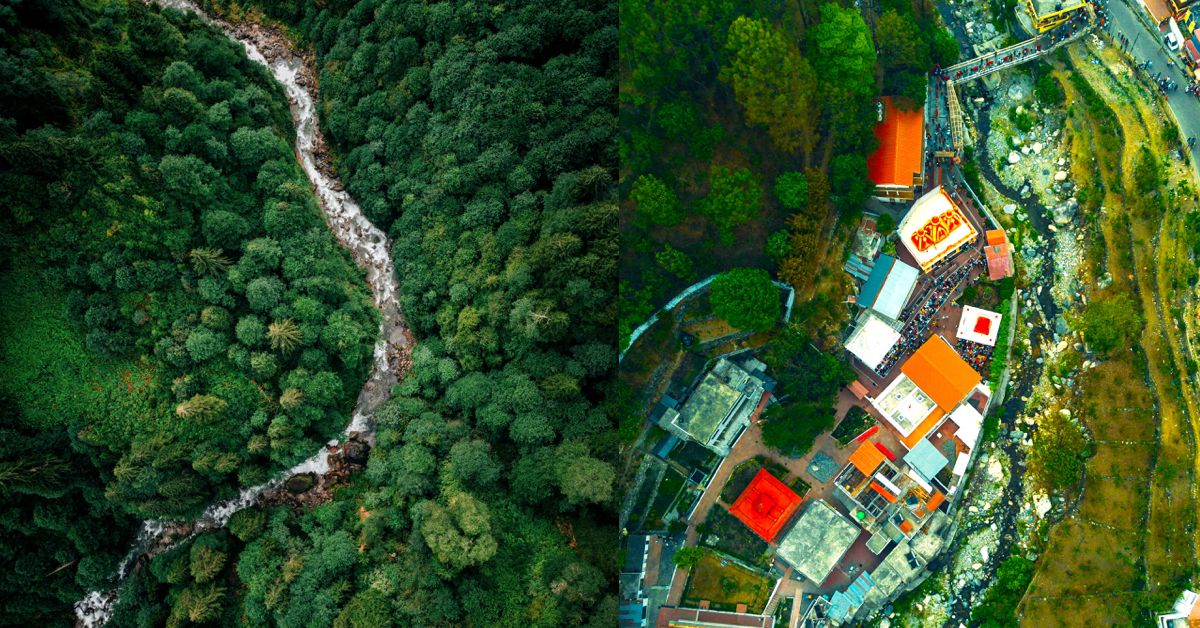
Free public images downloaded from http://www.pexels.com
What makes us believe that puṇya can be earned by destroying a being’s habitat and then compensating it with processed sugar laced with artificial colours? What moral logic allows us to call this generosity?
Perhaps the greatest puṇya lies in preservation—in leaving a riverbank uncut, in letting a grove remain a grove.
⸻
A Paradox We Refuse to Name
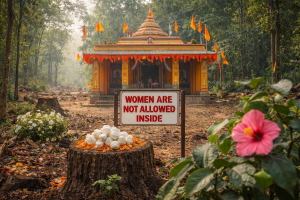
AI-generated representation
At the entrance of this forest temple, a board reads: Women are not allowed inside. Below it are the names and phone numbers of three men.
This paradox unsettles me deeply.
The temple stands in the heart of nature—created by cutting trees, by taking land from Mother Earth. Whenever I sit here, I feel the presence of the divine feminine everywhere: in soil and roots, in flowers and birds, in the quiet intelligence of the forest.
And yet, a few men stand on that very ground and declare that women may not enter.
I do not wish to offer a political argument, nor dismiss traditions that may have symbolic or psychological roots. I can respect the idea of different spaces for different inner journeys. But I cannot understand this: how can a place of worship exist in Prakriti and exclude the feminine?
Something here feels deeply violating. I cannot fully name it yet—but I cannot ignore it.
⸻
Rituals That Hurt and Kill
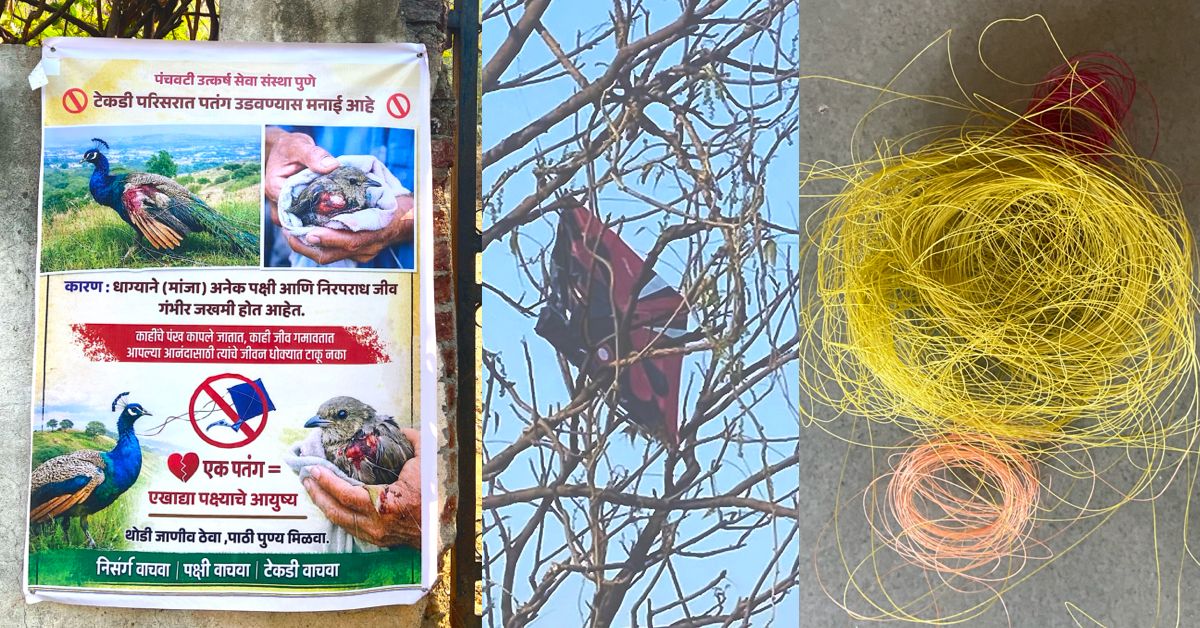
Last month, we celebrated Sankranti on this hillock—a harvest festival honoring farmers, Earth, and abundance. Fires were lit. Food was shared. Kites were flown using simple, reusable materials.
Today, we neither harvest nor share. Yet we fly kites with synthetic manja sharp enough to slice skin—let alone birds, animals, and human lives.
The hill near my house—a peacock sanctuary—is littered with lethal threads. I have seen birds wounded. Elders injured. In Mumbai, a five-year-old child died when leftover manja cut his throat. States like Gujarat report 20-25 deaths caused by Kite Manja each year, yet my highly educated and aware friends proudly post reels of kite-flying each Sankranti.
Why create artificial flight when real flight exists? Why not sit and witness the majestic Kite—the bird of prey—without control, without ego?
⸻
The Arguments That Hold Us Back
As I gathered what manja I could and began jogging home, three familiar arguments rose within me.
The religious argument:
We are small in the Darbar of the Great Lord. His ways are beyond us. This is tradition.
But from within that same sacred space, another voice rose: What if the Divine does not endorse what we do in His name?
Dhamma was never meant to protect rituals. It was meant to inspire right action.
The political argument:
Look at restored ghats. Renewed temples. Clean and radiant spaces.
The filth is not gone—only moved. The Earth still holds it. Rivers recede. Species disappear without ceremony. Civilizations do not collapse in a moment; they erode through justified neglect.
The practical argument:
Why obsess over a small temple? Industries pollute far more.
Perhaps. But is this not how we shrink our responsibility—by pointing upward? If our spiritual spaces cannot teach restraint, what authority do we claim to speak for the Earth?
⸻
A Call for Action
Then a deeper voice returned—quiet, unwavering:
“Who told you that you are small? Are you doing what lies within your capacity—right now? Or are you hiding inside stories of helplessness?“
I recalled a recent Human Development Report notes that 68% of people globally want to act on climate change—but hesitate because they believe they are alone.
What if the real illusion is not powerlessness, but isolation?
Not louder prayers.
Clearer action.
If this reflection stirred you—even slightly—that is the opening. Listening is not passive. It demands a response.
So let us begin:
- Sit in silence for three minutes—in a forest or below a tree. Feel its temple like sacredness. Ask the Earth what it needs. Then do it with full reverence.
- Pick up three things that do not belong there– Plastic. Paper. Manja. Bring it home and dispose of it consciously.
- Speak to three people from your family or friend circle. Gently. Share what you are seeing and doing to honour Earth. Walk together.
I am making these practices part of my life. Join me.
Earth is sacred.
Honoring her is the first act of worship.
— Manish Srivastava
(from the Sacred Well)
—
PS: All temple images are AI-generated representations. No real sacred sites were photographed, in respect of their sanctity. Other images are either downloaded from a free/ public source, http://www.pexels.com, or clicked by the author.
 the sacred well
more power to you manish and to conscious living. May the tribe grow in leaps and bounds.
LikeLike